Support a Camp
Who can be a community partner (Sponsor) to conduct a camp?
Any individual or voluntary social service organization - such as Lions, Rotary, religious groups, industries, trusts, banks, hospitals, community based NGOs, recreation and welfare clubs, farmers associations, village presidents - interested in the community welfare may sponsor an eye camp in terms of partnering with service providers. Imperial eye care expects the sponsors who are self motivated aiming to serve the community.
Sponsors' role
The sponsors have the primary role of setting up campsite preferably a school venue with the necessary support facilities viz. furniture, electricity, water etc. and also to care of the publicity needs. They are responsible for assembling patients and providing lodging and food for the medical team.
How to select an ideal place for a camp?
A village with a population of ten to twenty thousand including the surrounding areas in an accessible radius of 5 Kms is selected for conducting an eye camp. A convenient venue (such as a large school building in the area) and a suitable date (which does not interfere with local festivals, marriages and other functions or with other camps) will be selected for conducting the camp. The village should have good access to the nearby villages to benefit the patients around the main village.
The sponsors are supposed to:
- Delegate a separate team of members and volunteers to look after the community mobilization
- Arrange boarding and lodging for the medical team if the location is beyond 125km from the base hospital
- Arrange local transport facility for patients between the villages and the site of the camp, if the camp venue is not accessible within a radius of 5 to 10 Kms.
- Plan for manpower and finance to prepare the camp venue and conduct widespread publicity through all possible media. The camp organizer from Imperial eye care Eye Hospital works along with sponsor for effective execution of promotional activities
Comprehensive Eye Screening Programs
Comprehensive Screening Eye Camps
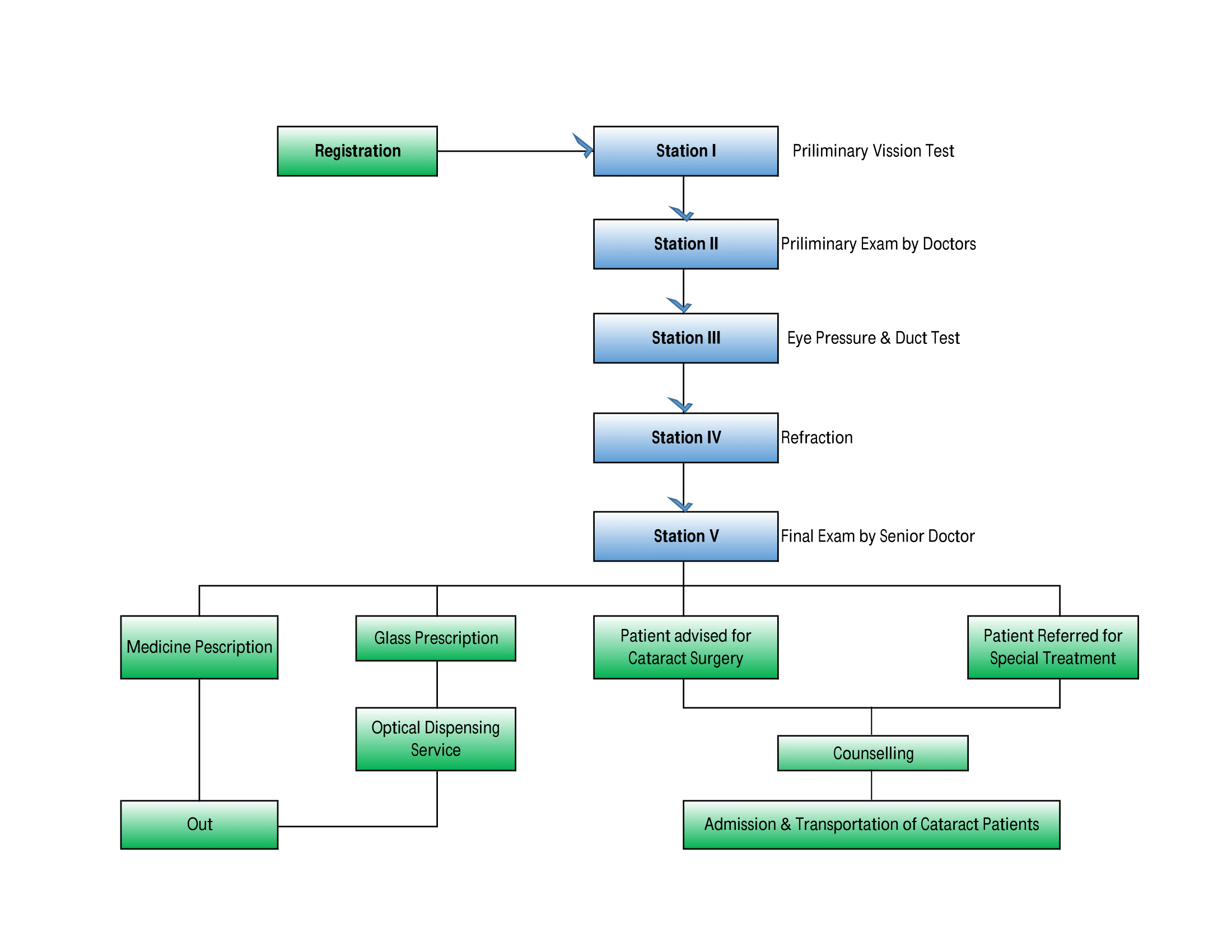
The clinical team (made up of Ophthalmologists and paramedical) examines all patients for eye problems with basic required instruments and equipments which includes dilation and fundus examination to some extent. Refraction is also done in the camp and eyeglasses are offered at affordable prices to support the service delivery system. People who need cataract surgery are counseled and transported to the base hospital. No surgery is performed at the camp.
Refer trip to an eye camp for understanding various steps in comprehensive eye screening in the community.
Diabetic Retinopathy Screening Camps
Diabetic retinopathy is damage (such as microaneurysms or hemorrhaging) to the small blood vessels in the retina (the thin light-sensitive membrane that covers the back of the eye) caused by complications of diabetes, namely chronically high blood glucose levels in people with poorly controlled diabetes.
According to the World Health Organization, 180 million people are affected by type 2 (formerly called adult-onset) diabetes worldwide, 41.9 million in India alone, the largest diabetic population of any nation in the world. These figures are expected to double by 2030. Various studies conducted in India show that 15-20% of the diabetic population develops diabetic retinopathy (DR).
Diabetic retinopathy screening camps are often held in conjunction with general hospitals (diabetes clinics) and diabetic associations, and include a large community education component. Because screening people for this disease requires special medical expertise, DR screening camps are specialized exclusively in the diagnosis and treatment of this disease. However, while the focus is on detecting diabetic retinopathy before it causes irreversible blindness (and this sometimes means detecting diabetes in patients who dont know they have it), patients who suffer from other eye disorders will also be referred to the eye care institution, eye clinic or specialty ophthalmology practice.
Workplace-Based Screening Eye Camps
It is estimated that 153 million people in the world have a visual impairment due to uncorrected refractive errors (visual acuity <6/18 or <20/60 in the better eye) and that is excluding presbyopia. In an aging world, the magnitude of uncorrected presbyopia is unimaginable. Because this is a problem among working populations, refractive error camps can be held for the sole purpose of screening and dispensing eyeglasses to large numbers of patients at one time. Industries and other fields of work that are likely to cause seeing disorders (or that are likely to suffer losses due to workers with poor vision) are also prime targets for this type of outreach camp.
Refractive error screening camps are conducted very similarly to cataract or comprehensive screening camps. Every patient is subjected to the same series of eye examinations, in the same order as in a regular screening camp Indeed, assessment of individuals who have refractive errors, particularly those aged 50 years or above, provides an opportunity for identifying other potentially blinding conditions before they cause visual loss (such as cataract, glaucoma and diabetic retinopathy).
School Children Screening Eye Camps
Globally, uncorrected refractive error is the main cause of vision impairment in children aged 6-15 years, and the prevalence of myopia (short-sightedness) is increasing dramatically among children. Outreach in schools concentrates on refractive error, which can lead to lack of academic success in school. Students with other eye ailments are also noted and referred to the base hospital.
Imperialeyecare prefers to conduct a short term orientation (about a day) for the teachers in the school premises based on 1:200 teacher-children ratio. The training covers anatomy and physiology of eye, common eye disorders among the children and visual acuity measurement. This exposure helps the teachers to conduct a preliminary assessment on the school children as a whole. This kind of assessment helps the imperialeyecare Medical team to conduct detailed eye examination on the children identified with eye problems. Also, the training for teachers helps to gain good ownership of the screening process effectively.
Paediatric Screening Eye Camps
Consider this. A child goes blind somewhere in the world every minute, yet much childhood blindness is preventable or treatable. Paediatric screening eye camps target babies and preschool-aged children and their parents, to educate about prevention (measles, harmful traditional eye remedies, eye safety) and to detect eye defects (congenital or traumatic), childhood illnesses and nutritional deficiencies that can lead to blindness:
- vitamin A deficiency
- corneal scarring
- congenital and traumatic cataract
- congenital glaucoma and retinopathy of prematurity (ROP)
- serious refractive errors
The process in a paediatric screening eye camp is quite similar to that of other screening camps. A major challenge of this type of camp is how to get more children with eye defects attending the camps. One way is through greater eye health education, targeted at young parents. Another way is to work with primary health centres, children health centres, family physicians, paediatricians, maternity clinics, preschools, and so on.